
Why I use them all: Substack, Medium, Linkedin etc
Why and how I write contents on 9 different platforms

First of all, I am not a writer. I don’t have a lot of followers or readers either. I am a co-founder for a tech startup company, and maybe spend 4 to 16 hours each week on various types of writing, not including internal-facing docs:
I write official product documentations in Markdown and publish to docs.timeplus.com
I publish more than half of the content on timeplus.com/blog
I work with our UX designer to publish biweekly product update on LinkedIn and also send out as marketing emails
I also maintain our Twitter/X account for the company
I have my own medium account and substack account
This even is not the complete list. But you get my point. I use multiple platforms for content writing. But why? Is that really necessary?
I think so.
The key is the boundary. I am a cofounder of a startup. So I probably work 15 hours a day. I am not looking for a job. I don’t need to gain $$ from the platforms. I do want to gain certain kinds of visibility, influence and credits from my readers. In the meanwhile, I have a strong motivate to share and express myself, even they are not so relevant to my company. That’s why I use 9 accounts in the same time and here is how:
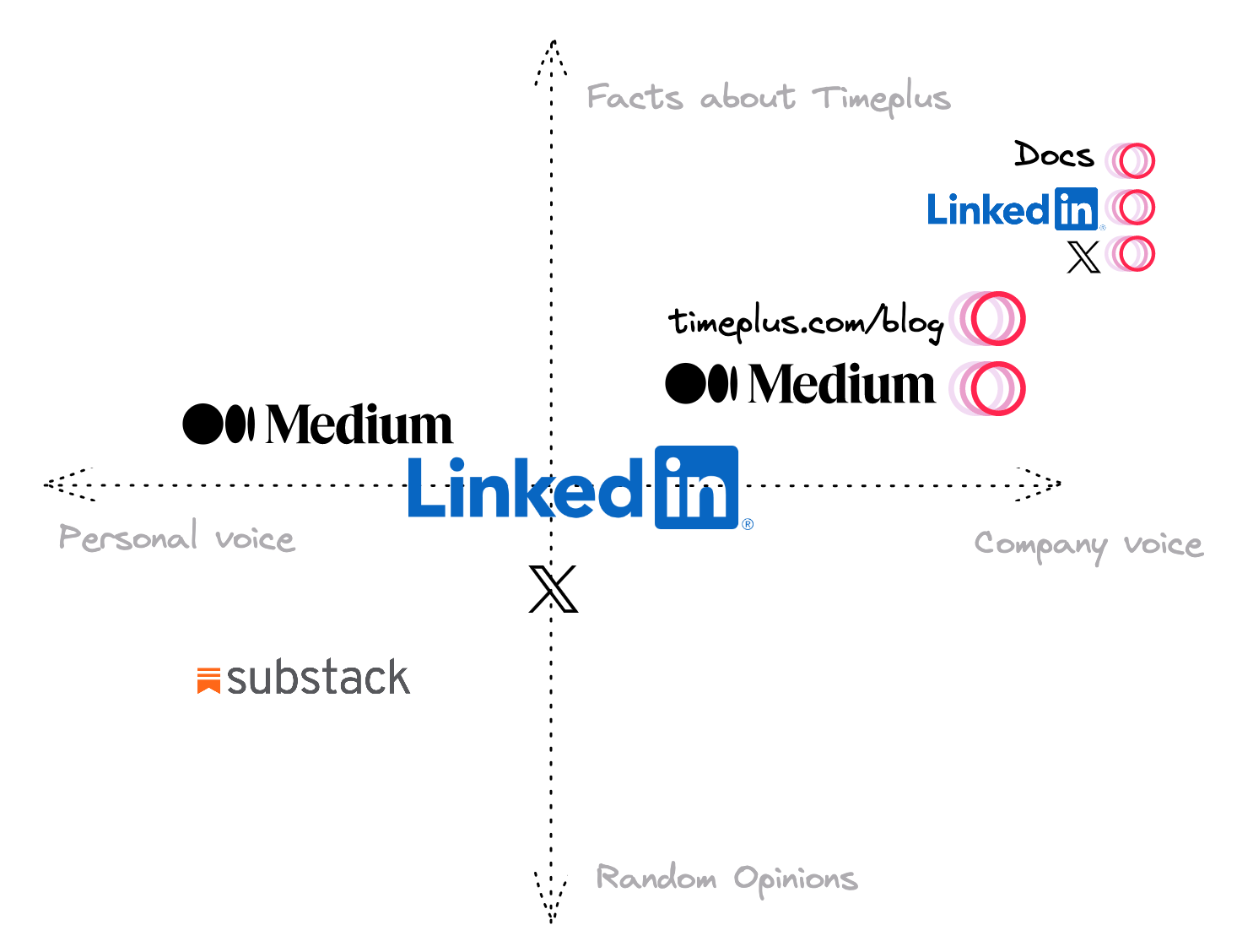
I’ve simplified the logic already, only leaving 2 dimensions.
X axis is whether this is for the company or for myself. As a cofounder, when I make comments for other products in our space, no matter competitors or partners, it’s hard to claim this is my personal opinion, not as statements from our company. But I still try to make it clear to others that, when I write something on medium or substack —without publishing to our company accounts— this is not meant to be an official message from the company.
Y axis is whether it’s fact or opinion, and how focus the content does to our company/product/service. I enjoy and need talk a lot about our company/product/service, but that is not the only topic. I may want to talk about the rest of data ecosystem, or software engineering in general, or my lesson&learns for startups, or just anything even non-tech.
I just draw the above diagram 2 hours ago but something similar in my mind for a while. This sets the boundaries for my content and hopefully my readers. e.g.
Company voice + Strong focus on product
docs.timeplus.com, the complete, accurate, official documentations
timeplus.com/blog, still my voice, but speak for our company. Case study, tutorial, announcement, etc
medium.com/www-timeplus-com, almost same as above blog. Using own blog increases SEO and branding. Using medium can expand readers.
linkedin.com/company/timeplusinc, publish product updates, share news or blogs
twitter.com/timeplusdata, someone told me developer can spend 4 hours a day on twitter. I don’t believe it but yes, most developers like twitter more than LinkedIn
Personal voice + tech topics
jove.medium.com, I don’t publish all my blogs to our company medium account, such as my experience attending Data Council , or how to setup websites in AWS or even how to edit audio/video.
Personal opinions
yes, this is what you are reading now. I am not reviewing any products(that will be in my personal medium). I don’t need to sell our product. I just want to express my opinions and hopefully make sense to some folks who happen to read it
Company voice + Random opinions
It’s common in such diagram. One corner doesn’t make sense at all
AND, my LinkedIn account is for almost everything. I don’t want to act fake on LinkedIn.
I don’t really use my own Twitter account, just to get updates for my friends and “classmates” in the data streaming space..
Again, not sure whether this post helps but I am glad to spend 0.5 hour writing this and publish it. You know what you can expect on different stuff I write in different platforms.
(maybe there are some typos or grammar issues. I don’t bother using AI or typechecker in my substack posts. You know what I mean).